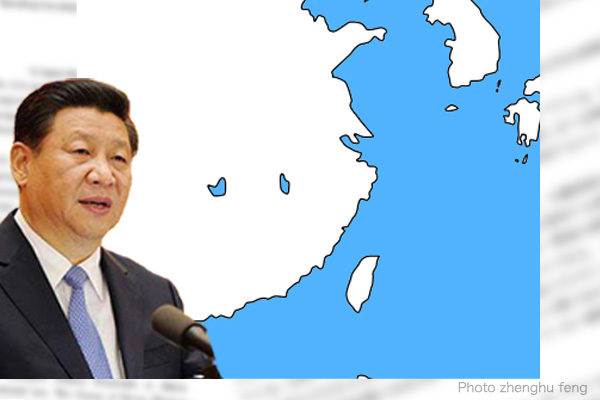
From late October to early November, the Chinese military conducted large-scale exercises involving three theater commands. The focus of China’s military drills has shifted from a naval blockade of Taiwan to blocking U.S. forces from coming to its aid, potentially advancing preparations for an invasion of the island one step further.
Even a nuclear strike on U.S. mainland simulated?
Following then-U.S. House Speaker Nancy Pelosi’s visit to Taiwan in 2022, the Chinese military’s Eastern Theater Command, which is primarily tasked with invading Taiwan, regularly conducted and publicized exercises focused on a naval blockade until 2025.
Although no large-scale exercises have been publicly reported this year, the following activities have been observed:
● From October 28 onward, four naval task groups belonging to the Northern, Eastern, and Southern Theater Command Navies conducted operations in the Western Pacific.
● From November 1 to 3, a large number of Chinese military aircraft advanced into the Western Pacific through the airspace above the Bashi Channel between Taiwan and the Philippines.
● From October 30 to November 8, maritime exclusion zones for military drills were established at amphibious landing training areas in the Eastern and Southern Theater Commands, and troops were massed there.
● On November 5, a Notice to Airmen (NOTAM), which warns commercial and other aircraft of dangerous airspace, was activated apparently for launching intercontinental ballistic missiles (ICBMs).
These events indicate that the Chinese military conducted exercises according to the following scenarios:
(1) Naval and air forces would block the approach of incoming U.S. forces in the waters and airspace from Taiwan’s east coast to the Western Pacific.
(2) Troops from the Eastern and Southern Theater Command Armies would land on Taiwan.
(3) A U.S.-China conflict would escalate to nuclear use, prompting the Rocket Force to launch nuclear strikes on the U.S. mainland.
Progressing preparations for invading Taiwan
The latest unpublicized major exercises significantly differ from earlier ones in three ways.
First, the focus of China’s military exercises has shifted from a naval blockade of Taiwan to blocking U.S. forces from coming to Taiwan’s aid. After completing the validation of its naval blockade capabilities in 2025, the Chinese military has launched full-scale testing of its anti-access capabilities against U.S. forces.
Second, multiple theater commands—not just the Eastern Theater Command—participated in the exercises. Apparently under the control of the Central Military Commission, the military tested operations to block U.S. forces. The commission, though currently having only one military official, controls 15 departments, such as the Joint Staff Department. These departments, which are responsible for actual military activities, are seemingly carrying out their duties steadily and without disruption.
Third, the Chinese military is pursuing unpublicized, more combat-realistic training. Until last year, large-scale exercises heavily involved cognitive warfare aimed at intimidating Taiwan by trumpeting naval blockade capabilities. However, the latest exercises featured drills closer to actual operations, as demonstrated by the advance of military aircraft into the Western Pacific through the Bashi Channel, avoiding the airspace above Okinawa, which hosts U.S. military bases.
As described above, the Chinese military under President Xi Jinping has been pushing forward with its reforms and advancing preparations for an invasion of Taiwan step by step in line with medium- to long-term plans. From next year on, Chinese military exercises may expand to test war-sustaining capabilities, including national defense mobilization and the shift to a wartime production posture.
Maki Nakagawa is a researcher at the Japan Institute for National Fundamentals and a former commander of the Basic Intelligence Unit, Japan Ground Self-Defense Force.
 Tsutomu Nishioka
 Takashi Arimoto
 Tadae Takubo
 Fumio Ota
 Yoshiko Sakurai
 Yasushi Tomiyama
 Masahiko Hosokawa
 Yoichi Shimada
 Hiroshi Yuasa
 Tadashi Narabayashi
 Hideo Tamura
 Kiyofumi Iwata
 Kunio Orita
 Etsuro Honda
 Yujiro Oiwa
 Shiro Takahashi
 Hironobu Ishikawa
 Katsuhiko Takaike
 Michio Ezaki
 Akira Momochi
 Akio Yaita
 Yoshihiko Yamada
 Seiji Kurosawa
 Koichi Endo
 Brahma Chellaney
 Nobuko Araki
 James Auer
 Yang Haiying
 Hiroshi Kimura
 Sumihiko Kawamura
 Takeshi Kudo
 Arvind Gupta
 Shohei Umezawa
 Jason Morgan
 Kenro Nagoshi
 Koko Kato
 Osamu Nishi
 Tadashi Saito
 Koji Okamoto
 Yumiko Nishimoto
 Tsutomu Toichi
 Kichinosuke Ihara
 Nobuyuki Sato
 Tadashi Ito
 Rikiwo Shikama
 Satoshi Hirano
 Sukehiro Hirakawa
 Lee Woo Young
 Toshu Noguchi
 Eriko Yamatani
 Koh Sekai
 Hideaki Karaki
 Yasuyuki Takai
 Koichi Furusho
 Taro Yayama
 Hisashi Matsumoto
 Katsuya Tsukamoto
 Seiichi Okutomi
 Tomoko Seo
 Akinaka Senzaki
 Hiroshi Ito
 Yen-Hung Lin
 Ryoichi Hamamoto
 Andrii Gurenko
 Saburo Tsukamoto
 Katsutoshi Kawano
 Kazuto Suzuki
 Kevin Maher
 Tomohisa Takei
 Sanae Takaichi
 Yang Yi
 Haruhisa Nakagawa
 Norihide Miyoshi
 Koichi Mera
 Satoshi Tomisaka
 Kazuhiko Inoue
 Akihisa Nagashima
 Mio Sugita
 Hong Hyung
 Keiichi Nakagawa
 Miki Kase
 Ronald Morse
 Yasuo Naito
 Toshio Watanabe
 Eitaro Ogawa
 Nobukatsu Fujioka
 Rupakjyoti Borah
 Satoshi Sakakibara
 Syunichi Akasofu
 Masamori Sase
 Chung Dae Kyun
 Hirotaka Watanabe
 Masanori Kondo
 Hidetake Sawa