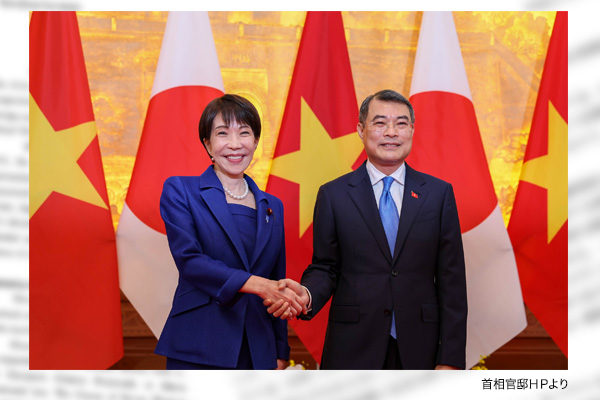
The once‑stalled nuclear cooperation between Japan and Vietnam has begun moving toward revival. When Japanese Prime Minister Sanae Takaichi visited Vietnam in May, the two countries agreed to promote discussions on potential cooperation in the nuclear field. Following that, the president of the Vietnam Atomic Energy Institute expressed strong interest in collaborating with Japan in developing small modular reactors (SMRs) at a meeting with a Japanese delegation including the author in Hanoi earlier this month.
Joint SMR development
In December last year, the Japanese government had to withdraw its support for Vietnam’s large-scale nuclear power plant construction project because it was found difficult to begin the plant’s commercial operation by 2035 as requested by Vietnam. As someone who had long worked toward realizing the export of the Advanced Boiling Water Reactor (ABWR) to Vietnam, this outcome was deeply disappointing.
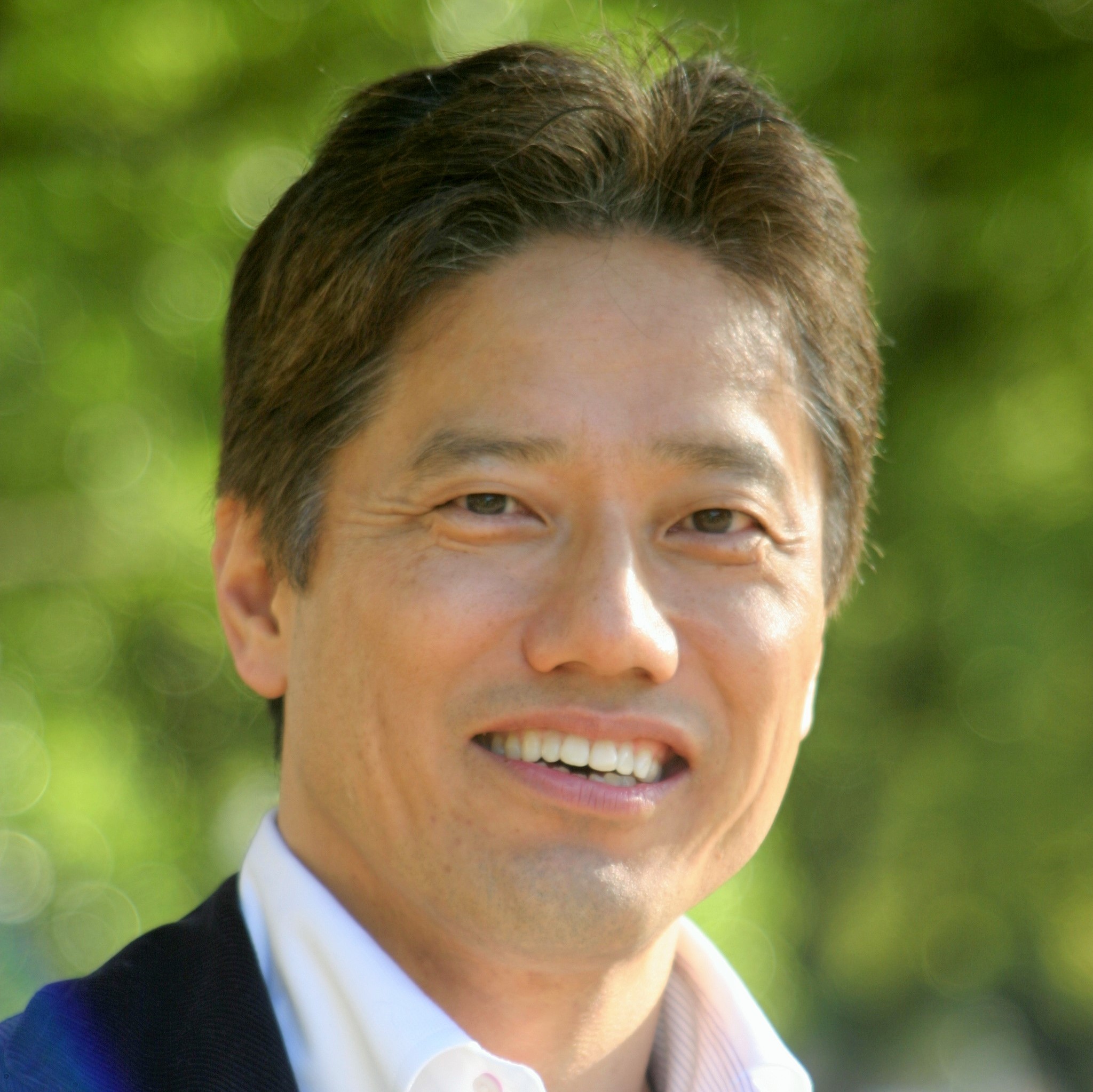
Therefore, I asked Masahiko Hosokawa, a Special Advisor to the Cabinet and professor at Meisei University, to encourage the Vietnamese side to request the revival of Japan-Vietnam nuclear cooperation during Takaichi’s visit to Vietnam. The list of priority items for economic security cooperation, released after the Japan-Vietnam summit, included a provision that says the two countries would “promote discussions on the potential for cooperation in the nuclear field from 2040 onward, in line with the needs and capabilities of the two sides.”
From July 19, the author visited Hanoi together with Seiki Soramoto, a former member of the House of Representatives from the Japan Innovation Party and president of the International Energy & Technology Development Support Organization, and Associate Professor Hiroshige Kikura of Institute of Science Tokyo (formerly the Tokyo Institute of Technology) to meet with Tran Chi Thanh, president of the Vietnam Atomic Energy Institute (VINATOM) to exchange views about Japan-Vietnam nuclear cooperation.
Thanh expressed his desire to develop SMRs and foster human resources jointly with Japan. The author explained that SMRs capable of adjusting output to match power demand would be suitable for joint development with Vietnam. The VINATOM president recognized that weather-dependent renewable energy sources such as solar power struggle to compensate for power shortages under Vietnam’s unstable power grids, expressing his hope to build many SMRs across the country’s long north–south expanse.
He also said Japan’s nuclear cooperation offer was timely as the National Assembly of Vietnam had already approved the development and construction of SMRs.
Implications for China strategy
During our stay in Hanoi, we also held a series of meetings with the presidents of Vietnam National University, Hanoi and Vietnam National University, Ho Chi Minh City, as well as with vice ministers from the Ministry of Education and Training and the Ministry of Science and Technology, who requested cooperation in human-resource development and technical collaboration with Japanese universities. Both sides agreed to address the shortening of SMR construction periods, the enhancement of safety, and the reduction of construction costs through joint research. The Vietnamese side also expressed hope to cooperate with Japan in preventing accidents with artificial intelligence (AI) and in utilizing rare earth resources buried in Vietnam.
Building a long-term cooperation with Vietnam in the nuclear field has significant implications for Japan’s strategy toward China, as it works to relatively curb Chinese influence in Southeast Asia. Japan should actively promote this initiative.
Tadashi Narabayashi is a professor emeritus at Hokkaido University and a director at the Japan Institute for National Fundamentals.
 Tsutomu Nishioka
 Takashi Arimoto
 Tadae Takubo
 Fumio Ota
 Yoshiko Sakurai
 Yasushi Tomiyama
 Masahiko Hosokawa
 Yoichi Shimada
 Hiroshi Yuasa
 Hideo Tamura
 Kiyofumi Iwata
 Kunio Orita
 Maki Nakagawa
 Etsuro Honda
 Yujiro Oiwa
 Shiro Takahashi
 Hironobu Ishikawa
 Katsuhiko Takaike
 Michio Ezaki
 Akira Momochi
 Yoshihiko Yamada
 Akio Yaita
 Seiji Kurosawa
 Brahma Chellaney
 Koichi Endo
 Nobuko Araki
 James Auer
 Yang Haiying
 Hiroshi Kimura
 Sumihiko Kawamura
 Arvind Gupta
 Shohei Umezawa
 Koko Kato
 Takeshi Kudo
 Jason Morgan
 Kenro Nagoshi
 Tadashi Saito
 Osamu Nishi
 Hisashi Matsumoto
 Tsutomu Toichi
 Kichinosuke Ihara
 Nobuyuki Sato
 Yumiko Nishimoto
 Toshu Noguchi
 Satoshi Hirano
 Hideaki Karaki
 Koji Okamoto
 Tadashi Ito
 Eriko Yamatani
 Lee Woo Young
 Rikiwo Shikama
 Sukehiro Hirakawa
 Taro Yayama
 Yasuyuki Takai
 Koh Sekai
 Koichi Furusho
 Sanae Takaichi
 Satoshi Tomisaka
 Yen-Hung Lin
 Ryoichi Hamamoto
 Andrii Gurenko
 Katsutoshi Kawano
 Kazuto Suzuki
 Kevin Maher
 Miki Kase
 Akihisa Nagashima
 Ronald Morse
 Hidetake Sawa
 Yang Yi
 Keiichi Nakagawa
 Seiichi Okutomi
 Haruhisa Nakagawa
 Hong Hyung
 Mio Sugita
 Tomohisa Takei
 Rupakjyoti Borah
 Masamori Sase
 Chung Dae Kyun
 Hirotaka Watanabe
 Masanori Kondo
 Koichi Mera
 Syunichi Akasofu
 Satoshi Sakakibara
 Hiroshi Ito
 Toshio Watanabe
 Nobukatsu Fujioka
 Eitaro Ogawa
 Saburo Tsukamoto
 Kazuhiko Inoue
 Norihide Miyoshi
 Yasuo Naito
 Katsuya Tsukamoto
 Akinaka Senzaki