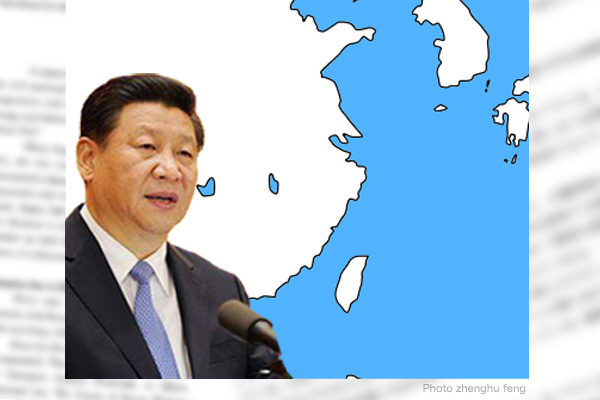
The Eastern Theater Command of the Chinese People’s Liberation Army, whose primary mission is an invasion of Taiwan, conducted a joint exercise called “Justice Mission-2025” from December 29 to 31 last year. Judging from Chinese official reports and other publicly available information, the exercise was likely focused on denying U.S. forces access.
Missiles reaching beyond first island chain shown
On December 29, the Eastern Theater Command launched the Justice Mission-2025 joint exercise of army, navy, air force, and rocket force in five locations around Taiwan, announcing that the exercise was “a stern warning to ‘Taiwan independence’ separatist forces and external interference." On December 30, it conducted live-fire drills in which long-range multiple rocket launchers on the Chinese coast fired into navigation restriction zones designated in the air and sea spaces north and southwest of Taiwan. The exercise lasted effectively for two days before its end was declared on December 31.
Since then-U.S. House Speaker Nancy Pelosi visited Taiwan in 2022, the Eastern Theater Command has announced one or two joint exercise per year around Taiwan. The April 2025 joint exercise was described as “a stern warning to ‘Taiwan independence’ separatist forces” and was marked by strong elements of a maritime blockade against Taiwan. The December exercise declared that its targets included not only Taiwan but also “external interference.” Its promotional poster depicted Chinese forces blocking U.S. transport aircraft and a U.S. nuclear submarine as well as cargo ships loaded with U.S. high mobility artillery rocket systems, or HIMARS, of which additional sales were approved by the United States on December 18.
Official reports on the exercise broadcast the movement of launchers for the DF-17 medium-range ballistic missile, which has a range of 2,000 kilometers, and the DF-26 intermediate-range ballistic missile, which has a range of 3,000-4,000 kilometers. Both missiles are believed to be targeting U.S. warships and military bases. Short‑range ballistic missiles aimed at Taiwan have consistently appeared in reports on past joint exercises, but this is likely the first time that the appearance of the DF‑17 and DF‑26, designed to strike targets beyond the First Island Chain (running from Japan through Taiwan to the Philippines), have been confirmed.
The two missiles have both land‑attack and anti‑ship capabilities, and although no live firing took place, they were likely used in simulated joint strike training in coordination with naval and air forces, targeting U.S. vessels approaching from the direction of Guam to support Taiwan.
Japan should hurry to develop deterrence against China
The apparent shift in this exercise toward focusing on denying U.S. forces access can be seen as a form of a warning to the U.S. ahead of U.S. President Donald Trump’s planned visit to China in April, but it also reflects the fact that the Chinese military’s long‑range strike capabilities have been steadily expanding year by year.
China has been waging a campaign accusing Japan of military expansion and a revival of militarism ever since Prime Minister Sanae Takaichi’s remarks last November about a “survival‑threatening situation.” However, the main hypothetical enemy in the year‑end exercise was the U.S., and the training was not focused on Japan. It appears that China regards Japan merely as a subordinate follower of the U.S. and has judged that, for now, measures such as cognitive warfare and intimidation through actions like radar illumination are sufficient to deal with it.
At a time when China is pressing ahead with preparations to be ready to invade Taiwan by 2027, Japan, if it truly wishes for peace and stability in the Taiwan Strait, must calmly analyze what kind of deterrent capability it should possess vis‑à‑vis China and move swiftly to put it in place.
Maki Nakagawa is a researcher at the Japan Institute for National Fundamentals and a former commander of the Basic Intelligence Unit, Japan Ground Self-Defense Force.
 Tsutomu Nishioka
 Takashi Arimoto
 Tadae Takubo
 Fumio Ota
 Yoshiko Sakurai
 Yasushi Tomiyama
 Masahiko Hosokawa
 Yoichi Shimada
 Hiroshi Yuasa
 Tadashi Narabayashi
 Hideo Tamura
 Kiyofumi Iwata
 Kunio Orita
 Etsuro Honda
 Yujiro Oiwa
 Shiro Takahashi
 Hironobu Ishikawa
 Katsuhiko Takaike
 Michio Ezaki
 Akira Momochi
 Yoshihiko Yamada
 Akio Yaita
 Seiji Kurosawa
 Brahma Chellaney
 Koichi Endo
 Nobuko Araki
 James Auer
 Yang Haiying
 Hiroshi Kimura
 Sumihiko Kawamura
 Arvind Gupta
 Shohei Umezawa
 Koko Kato
 Takeshi Kudo
 Jason Morgan
 Kenro Nagoshi
 Tadashi Saito
 Osamu Nishi
 Hisashi Matsumoto
 Tsutomu Toichi
 Kichinosuke Ihara
 Nobuyuki Sato
 Yumiko Nishimoto
 Toshu Noguchi
 Satoshi Hirano
 Hideaki Karaki
 Koji Okamoto
 Tadashi Ito
 Eriko Yamatani
 Lee Woo Young
 Rikiwo Shikama
 Sukehiro Hirakawa
 Taro Yayama
 Yasuyuki Takai
 Koh Sekai
 Koichi Furusho
 Sanae Takaichi
 Satoshi Tomisaka
 Yen-Hung Lin
 Ryoichi Hamamoto
 Andrii Gurenko
 Katsutoshi Kawano
 Kazuto Suzuki
 Kevin Maher
 Miki Kase
 Akihisa Nagashima
 Ronald Morse
 Hidetake Sawa
 Yang Yi
 Keiichi Nakagawa
 Seiichi Okutomi
 Haruhisa Nakagawa
 Hong Hyung
 Mio Sugita
 Tomohisa Takei
 Rupakjyoti Borah
 Masamori Sase
 Chung Dae Kyun
 Hirotaka Watanabe
 Masanori Kondo
 Koichi Mera
 Syunichi Akasofu
 Satoshi Sakakibara
 Hiroshi Ito
 Toshio Watanabe
 Nobukatsu Fujioka
 Eitaro Ogawa
 Saburo Tsukamoto
 Kazuhiko Inoue
 Norihide Miyoshi
 Yasuo Naito
 Katsuya Tsukamoto
 Akinaka Senzaki