Since the dismissal of the commander and political commissar of the People’s Liberation Army Rocket Force in 2023, media reports have suggested a potential decline in its operational capabilities due to confusion in the chain of command amid a downfall of senior officials within the force and the PLA’s equipment procurement departments. However, analysis of satellite images of missile test ranges in inland China shows the PLA Rocket Force’s continuation of missile development tests and live-fire training, suggesting the gradual enhancement of its missile capabilities.
Suspected antiship missile live-fire training in April
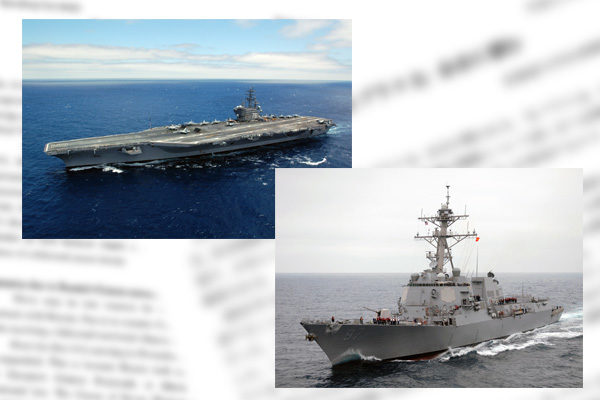
At the Ruoqiang missile range in the Xinjiang Uyghur Autonomous Region, targets closely resembling U.S. warships in size and shape have been identified since 2019, and the number and types of these mock targets have been increasing each year. What initially involved firing at a single target modeled after a U.S. aircraft carrier later expanded to include targets shaped like Arleigh Burke–class destroyers placed ahead of and behind the carrier, and starting in 2025, a target modeled after the carrier‑borne E‑2 early warning aircraft was also installed. The installation of targets modeled after carrier‑borne aircraft appears to be intended to test whether anti‑ship missiles can avoid being diverted toward aircraft in flight and instead accurately home in on the carrier. China may be verifying its missile‑guidance capabilities under more realistic operational conditions.
In addition, since 2021, it has operated two mock warship targets moving along rails about 37 kilometers long. Satellite images from September 22, 2023, confirmed impact marks on one of the mobile targets. This means that the PLA Rocket Force has the capability to strike antiship missiles on moving warships. The mock target with impact marks was left on rails for about 10 months until it was repaired for the next live-fire test. It is conceivable that the Rocket Force tried to demonstrate a warning to the United States by leaving the target with impact marks to be recognized by U.S. reconnaissance satellites.
Satellite images show that these mock carrier strike group and mobile warship targets have been damaged and repaired about once a year, indicating live-fire tests have been ongoing. Images from April 17, 2026, confirmed that the repaired carrier and destroyer targets were damaged around the same time, indicating that antiship missiles were fired consecutively in April against the mock U.S. carrier strike group. The two mobile warship targets were found repaired and placed on rails on May 10 and 21, suggesting that preparations for this year’s live-fire training were complete.
Improved capabilities of the Rocket Force
The Military Balance 2026, published by the International Institute for Strategic Studies, a British think tank, assessed that the DF-27 ballistic missile, which has a range of 8,000 kilometers and is equipped with a hypersonic glide vehicle, and the CJ-1000 ground-launched cruise missile, which has an estimated range of over 4,000 kilometers, were entering service this year.
China continues to develop new missiles and, after conducting live‑fire verification at its missile test ranges, is gradually bringing them into operational service. At the same time, it is maintaining live‑fire training with missiles already deployed to its units, thereby improving their ability to strike accurately under more realistic conditions. Judging from the missile test ranges, the PLA Rocket Force appears to have been steadily enhancing its missile capabilities despite the confusion accompanying the senior personnel reshuffle.
Maki Nakagawa is a researcher at the Japan Institute for National Fundamentals and a former commander of the Basic Intelligence Unit, Japan Ground Self-Defense Force.
 Tsutomu Nishioka
 Takashi Arimoto
 Tadae Takubo
 Fumio Ota
 Yoshiko Sakurai
 Yasushi Tomiyama
 Masahiko Hosokawa
 Yoichi Shimada
 Hiroshi Yuasa
 Tadashi Narabayashi
 Hideo Tamura
 Kiyofumi Iwata
 Kunio Orita
 Etsuro Honda
 Yujiro Oiwa
 Hironobu Ishikawa
 Shiro Takahashi
 Katsuhiko Takaike
 Michio Ezaki
 Akira Momochi
 Akio Yaita
 Yoshihiko Yamada
 Seiji Kurosawa
 Koichi Endo
 Brahma Chellaney
 Nobuko Araki
 Yang Haiying
 James Auer
 Sumihiko Kawamura
 Hiroshi Kimura
 Osamu Nishi
 Koko Kato
 Tadashi Saito
 Shohei Umezawa
 Jason Morgan
 Arvind Gupta
 Kenro Nagoshi
 Takeshi Kudo
 Sukehiro Hirakawa
 Yumiko Nishimoto
 Rikiwo Shikama
 Eriko Yamatani
 Koichi Furusho
 Tadashi Ito
 Satoshi Hirano
 Lee Woo Young
 Taro Yayama
 Koh Sekai
 Koji Okamoto
 Tsutomu Toichi
 Hideaki Karaki
 Toshu Noguchi
 Kichinosuke Ihara
 Hisashi Matsumoto
 Yasuyuki Takai
 Nobuyuki Sato
 Chung Dae Kyun
 Toshio Watanabe
 Katsuya Tsukamoto
 Kazuto Suzuki
 Koichi Mera
 Akihisa Nagashima
 Miki Kase
 Eitaro Ogawa
 Hirotaka Watanabe
 Akinaka Senzaki
 Kevin Maher
 Yang Yi
 Hidetake Sawa
 Satoshi Tomisaka
 Nobukatsu Fujioka
 Masanori Kondo
 Hiroshi Ito
 Mio Sugita
 Rupakjyoti Borah
 Seiichi Okutomi
 Saburo Tsukamoto
 Yasuo Naito
 Satoshi Sakakibara
 Yen-Hung Lin
 Sanae Takaichi
 Haruhisa Nakagawa
 Norihide Miyoshi
 Syunichi Akasofu
 Ryoichi Hamamoto
 Hong Hyung
 Andrii Gurenko
 Ronald Morse
 Kazuhiko Inoue
 Keiichi Nakagawa
 Masamori Sase
 Katsutoshi Kawano
 Tomohisa Takei