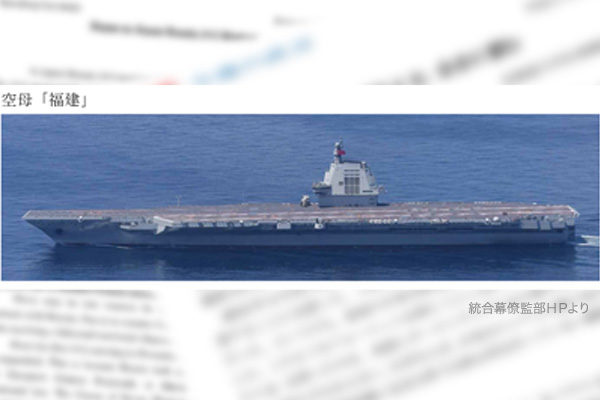
China is building a large vessel, believed to be its fourth aircraft carrier, at a dockyard in Dalian, Liaoning Province. Satellite images confirm that frames similar to those for a nuclear reactor containment vessel have been installed, suggesting a strong possibility that China has begun to build its first nuclear aircraft carrier.
Frames inside the hull resemble those for a reactor containment vessel
The construction site is a dockyard owned by Dalian Shipbuilding Industry Group Co., where the Shandong, the first Chinese-built aircraft carrier and the second among the three existing Chinese carriers, was constructed.
Since February this year, a keel block to support the hull during shipbuilding has been confirmed at the dockyard. The keel block has been installed over a total length of more than 270 meters, suggesting preparations for building a ship as large as an aircraft carrier. Satellite images on November 10 show that a hull component that measures 150 meters long and 43 meters wide was assembled. Installed inside the hull component are two frames that each measure 16 meters long and 14 meters wide. Such frames were never confirmed during the construction of the Shandong and the Fujian, both of which are conventionally powered aircraft carriers. The Fujian was commissioned on November 5 as China’s third aircraft carrier and the second constructed domestically.
Satellite images of the Newport News Shipyard in Virginia, where U.S. Navy nuclear aircraft carriers are built, show two frames — each measuring 16 meters long and 13 meters wide — at the position for a nuclear reactor containment vessel for an aircraft carrier under construction. The frames are very similar in size and shape to those observed at the Dalian dockyard.
Service entry possible in early 2030s
Last month, China commissioned the Fujian with an electromagnetic catapult for launching aircraft, establishing a three-carrier system. However, the other two are ski-jump carriers that cannot operate beyond the first island chain (from Japan to Taiwan and the Philippines) in wartime. The three carriers with different capabilities cannot necessarily complete a rotation system covering maintenance checks, training, and mission. Furthermore, the conventionally powered Fujian raises questions about its ability to provide stable power supply required for the continuous launch of aircraft, in contrast to nuclear-powered carriers.
Therefore, China is aiming for a catapult-type nuclear aircraft carrier as its next carrier. From groundbreaking to commissioning, the Shandon took six years and one month and the Fujian seven years. If the large ship being built at the Dalian dockyard is a nuclear aircraft carrier, China will have an aircraft carrier as capable as a U.S. nuclear carrier in the early 2030s. Furthermore, China may continue to build nuclear carriers to complete a rotation system with three nuclear carriers toward its goal of achieving a world-class military by 2049 to mark the 100th anniversary of the People’s Republic.
How will the Chinese Navy with increasing aircraft carriers confront the U.S. Navy now with 11 nuclear carriers and change its operations around Japan toward the goal? We must watch the construction of aircraft carriers at Chinese dockyards, the functional status of the Fujian’s electromagnetic catapult, and the training status of the three existing Chinese aircraft carriers.
Maki Nakagawa is a researcher at the Japan Institute for National Fundamentals and a former commander of the Basic Intelligence Unit, Japan Ground Self-Defense Force.
 Tsutomu Nishioka
 Takashi Arimoto
 Tadae Takubo
 Fumio Ota
 Yoshiko Sakurai
 Yasushi Tomiyama
 Masahiko Hosokawa
 Yoichi Shimada
 Hiroshi Yuasa
 Tadashi Narabayashi
 Hideo Tamura
 Kiyofumi Iwata
 Kunio Orita
 Etsuro Honda
 Yujiro Oiwa
 Hironobu Ishikawa
 Shiro Takahashi
 Katsuhiko Takaike
 Michio Ezaki
 Akira Momochi
 Akio Yaita
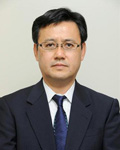 Yoshihiko Yamada
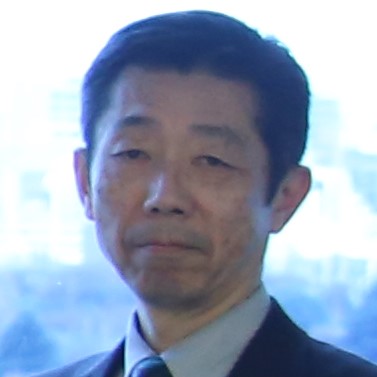 Seiji Kurosawa
 Koichi Endo
 Brahma Chellaney
 Nobuko Araki
 Yang Haiying
 James Auer
 Sumihiko Kawamura
 Hiroshi Kimura
 Osamu Nishi
 Koko Kato
 Tadashi Saito
 Shohei Umezawa
 Jason Morgan
 Arvind Gupta
 Kenro Nagoshi
 Takeshi Kudo
 Sukehiro Hirakawa
 Yumiko Nishimoto
 Rikiwo Shikama
 Eriko Yamatani
 Koichi Furusho
 Tadashi Ito
 Satoshi Hirano
 Lee Woo Young
 Taro Yayama
 Koh Sekai
 Koji Okamoto
 Tsutomu Toichi
 Hideaki Karaki
 Toshu Noguchi
 Kichinosuke Ihara
 Hisashi Matsumoto
 Yasuyuki Takai
 Nobuyuki Sato
 Chung Dae Kyun
 Toshio Watanabe
 Katsuya Tsukamoto
 Kazuto Suzuki
 Koichi Mera
 Akihisa Nagashima
 Miki Kase
 Eitaro Ogawa
 Hirotaka Watanabe
 Akinaka Senzaki
 Kevin Maher
 Yang Yi
 Hidetake Sawa
 Satoshi Tomisaka
 Nobukatsu Fujioka
 Masanori Kondo
 Hiroshi Ito
 Mio Sugita
 Rupakjyoti Borah
 Seiichi Okutomi
 Saburo Tsukamoto
 Yasuo Naito
 Satoshi Sakakibara
 Yen-Hung Lin
 Sanae Takaichi
 Haruhisa Nakagawa
 Norihide Miyoshi
 Syunichi Akasofu
 Ryoichi Hamamoto
 Hong Hyung
 Andrii Gurenko
 Ronald Morse
 Kazuhiko Inoue
 Keiichi Nakagawa
 Masamori Sase
 Katsutoshi Kawano
 Tomohisa Takei