South Korean President Lee Jae Myung visited China from January 4 to 7 and Japan from January 13 to 14. During the visits, Lee sealed anti-Japan diplomacy that brings historical perceptions into foreign policy. This reflects the practical diplomacy he advocates that give priority to national interests. Because his supporters are dissatisfied with his stance, Lee has been waging a history war at home over modern South Korean history as a way to let off steam. Conservatives have pushed back, and the authors of the best-selling book “Anti-Japan Tribalism,” which exposed the falsehood in the anti-Japan movement, have launched a national movement to establish a new view of history.
Abandoning a history war with Japan
Chinese President Xi Jinping told Lee, who visited China as a state guest, that he should stand on the correct side of history (that is, China’s side) and make the right strategic choices, effectively calling for a joint anti-Japan action on historical issues. At the press conference, however, Lee played down Xi’s remarks, saying, “I took them as Confucius’ words,” and did not echo China’s criticism of Japan.
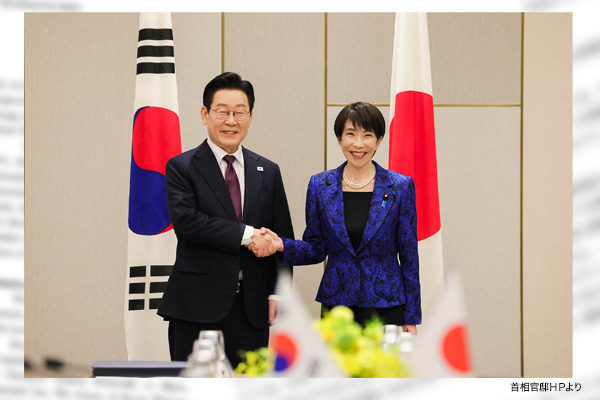
At his summit meeting with Japanese Prime Minister Sanae Takaichi in Nara, Lee shied away from criticizing Japan over historical issues. Takaichi announced DNA testing of the remains of Korean and Japanese workers who died in a coal mine accident in Yamaguchi Prefecture during World War II, in a gesture of consideration toward Lee.
What comes to mind is the scene in November 1995, just three months after then-Japanese Prime Minister Tomichi Murayama’s statement apologizing Japan’s past aggression in Asia, when Jiang Zemin became the first Chinese president to visit South Korea and joined then-South Korean President Kim Yong Sam in criticizing Japan over historical issues at a joint press conference. It feels like a different era altogether.
Meanwhile, on October 19 last year, Lee marked the 77th anniversary of the 1948 Yeosu-Suncheon rebellion, which claimed many lives, by praising rebel soldiers for “standing up to unjust orders to turn their guns on the people” and said that many soldiers and civilians were killed in the course of the suppression. This reflected a view of history that rebel soldiers were heroes and regular army that put down the rebellion were massacrers.
In reality, the incident was a rebellion in which communists launched an armed uprising on Jeju Island, and the 14th Regiment of the National Defense Guard stationed in Yeosu and Suncheon was ordered to suppress it. More than 2,000 soldiers of the regiment refused the order, killed members of the military, police, government officials, and ruling‑party members, and seized control of the eastern part of South Jeolla Province, or Jeollanam-do. During the suppression, civilians who had no connection to the rebellion also became victims.
Moreover, on December 15 last year, Lee ordered the cancellation of the national merit award for regimental commander Park Jin Kyung, who was assassinated by his subordinates during the suppression of the 1948 Jeju Island uprising, even though the procedure for the award had already been completed. Leftists criticize Park’s harsh suppression as resulting in a large number of civilian casualties, but he was in charge of the operation for only 40 days and there were not many civilian casualties during the period. The award was applied for by his bereaved family in accordance with the regulations, on the basis of the Order of Military Merit that had been conferred immediately after the assassination.
Conservatives start a national movement
Lee Young Hoon, a former professor at Seoul National University who edited and authored “Anti-Japan Tribalism,” announced the launch of a New History National Movement. He vowed to organize a movement with a large number of people, out of a strong sense of crisis that the country will not have a future unless it denies the modern and contemporary history view that is now being talked about and taught in South Korea and establishes a new view of history. Lee told me that if the Chinese Communist Party invades Taiwan by force, South Korea should participate in a war to defend Taiwan and that the founding philosophy of South Korea is to protect freedom and fight for it.
Tsutomu Nishioka is a senior fellow and a Planning Committee member at the Japan Institute for National Fundamentals and a visiting professor at Reitaku University. He covers South and North Koreas.
 Takashi Arimoto
 Tadae Takubo
 Fumio Ota
 Yoshiko Sakurai
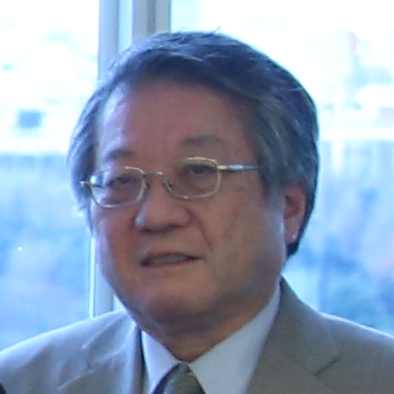 Yasushi Tomiyama
 Masahiko Hosokawa
 Yoichi Shimada
 Hiroshi Yuasa
 Tadashi Narabayashi
 Hideo Tamura
 Kiyofumi Iwata
 Kunio Orita
 Maki Nakagawa
 Etsuro Honda
 Yujiro Oiwa
 Shiro Takahashi
 Hironobu Ishikawa
 Katsuhiko Takaike
 Michio Ezaki
 Akira Momochi
 Yoshihiko Yamada
 Akio Yaita
 Seiji Kurosawa
 Brahma Chellaney
 Koichi Endo
 Nobuko Araki
 James Auer
 Yang Haiying
 Hiroshi Kimura
 Sumihiko Kawamura
 Arvind Gupta
 Shohei Umezawa
 Koko Kato
 Takeshi Kudo
 Jason Morgan
 Kenro Nagoshi
 Tadashi Saito
 Osamu Nishi
 Hisashi Matsumoto
 Tsutomu Toichi
 Kichinosuke Ihara
 Nobuyuki Sato
 Yumiko Nishimoto
 Toshu Noguchi
 Satoshi Hirano
 Hideaki Karaki
 Koji Okamoto
 Tadashi Ito
 Eriko Yamatani
 Lee Woo Young
 Rikiwo Shikama
 Sukehiro Hirakawa
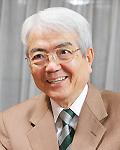 Taro Yayama
 Yasuyuki Takai
 Koh Sekai
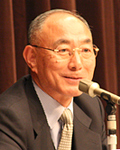 Koichi Furusho
 Sanae Takaichi
 Satoshi Tomisaka
 Yen-Hung Lin
 Ryoichi Hamamoto
 Andrii Gurenko
 Katsutoshi Kawano
 Kazuto Suzuki
 Kevin Maher
 Miki Kase
 Akihisa Nagashima
 Ronald Morse
 Hidetake Sawa
 Yang Yi
 Keiichi Nakagawa
 Seiichi Okutomi
 Haruhisa Nakagawa
 Hong Hyung
 Mio Sugita
 Tomohisa Takei
 Rupakjyoti Borah
 Masamori Sase
 Chung Dae Kyun
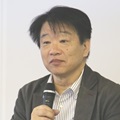 Hirotaka Watanabe
 Masanori Kondo
 Koichi Mera
 Syunichi Akasofu
 Satoshi Sakakibara
 Hiroshi Ito
 Toshio Watanabe
 Nobukatsu Fujioka
 Eitaro Ogawa
 Saburo Tsukamoto
 Kazuhiko Inoue
 Norihide Miyoshi
 Yasuo Naito
 Katsuya Tsukamoto
 Akinaka Senzaki