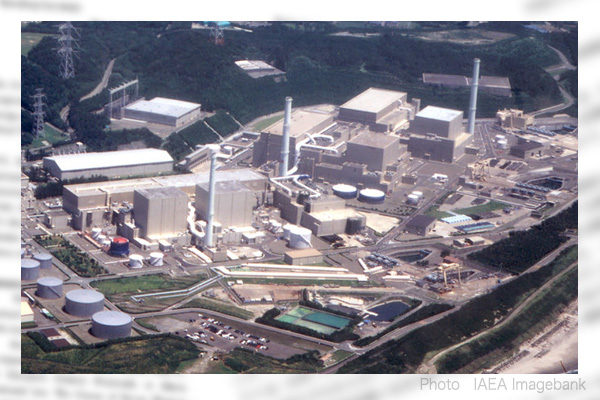
Chubu Electric Power Co. was found to have possibly underestimated the expected earthquake ground motion (the “design basis seismic ground motion”) in the safety review of the Hamaoka Nuclear Power Station in Shizuoka Prefecture. Citing the possibility of intentional misconduct, the Nuclear Regulation Authority declared the suspension of the safety review for the station. Since the design basis seismic ground motion serves as the standard for all seismic designs, and its reliability can no longer be guaranteed, it is inevitable that the seismic analysis and its years-long review will have to be redone in full.
Law does not envisage long-term reviews
Chubu Electric Power told the NRA that a seismic wave that is the closest to the average of 20 seismic wave patterns under different computation conditions would be selected as a representative seismic wave used to determine the design basis seismic ground motion. In reality, however, the company created many 20-pattern sets and deliberately selected one set among them. Since around 2018, the company has selected a seismic wave that was not close to the average as a representative wave and chosen the 19 other patterns so that the representative wave becomes the closest to the average of the 20 patterns, producing a final set of the 20 patterns and the representative seismic wave.
Such a method of determining the design basis ground motion—one that could be judged as fraudulent—requires “benchmark analyses” in forums such as the seismic design subcommittee of the Japan Electric Association, where experts participate in establishing standards for seismic evaluation methods for nuclear power plants. In these analyses, data from multiple ground sites with known outcomes are input into a computer, and the calculated results are compared with the earthquake motions actually observed.
Regarding the Hamaoka nuclear power plant case, there are also problems on the part of the NRA. The Administrative Procedure Act stipulates that the prerequisites and analysis procedures for a review must be clarified in advance to secure fairness, transparency, and protection of people’s rights, and that any review must end within about two years. Review procedures cannot be changed during any review. For some nuclear power plants, however, a safety review has taken 15 years because the NRA added new issues one after another at review meetings. The NRA, while being an administrative organization, fails to comply with the Administrative Procedure Act even 15 years after the Fukushima nuclear plant accident caused by the Great East Japan Earthquake. In the United States, President Donald Trump has instructed the review period to be shortened from two years to one and a half years.
Follow the U.S. utilization of AI
Last week, I participated in a North American symposium of the Information System on Occupational Exposure that monitors nuclear accidents around the world, and learned that the U.S. Nuclear Regulatory Commission is developing a method to use artificial intelligence to check whether there is any intentional fraud. AI can check tens of thousands of pages of applications in less than 10 minutes. A safety review system using AI to detect fraud should be developed.
A prolonged safety review will lead to electricity price hikes and places a heavier burden on vulnerable households. Japan should also introduce an AI-using safety review. I have proposed this through a meeting with the NRA Secretariat at the Japan Society of Maintenology. The secretariat is positive about the proposal.
Tadashi Narabayashi is Professor of Special Recognition at the Institute of Science Tokyo and a director at the Japan Institute for National Fundamentals.
 Tsutomu Nishioka
 Takashi Arimoto
 Tadae Takubo
 Fumio Ota
 Yoshiko Sakurai
 Yasushi Tomiyama
 Masahiko Hosokawa
 Yoichi Shimada
 Hiroshi Yuasa
 Hideo Tamura
 Kiyofumi Iwata
 Kunio Orita
 Maki Nakagawa
 Etsuro Honda
 Yujiro Oiwa
 Shiro Takahashi
 Hironobu Ishikawa
 Katsuhiko Takaike
 Michio Ezaki
 Akira Momochi
 Yoshihiko Yamada
 Akio Yaita
 Seiji Kurosawa
 Brahma Chellaney
 Koichi Endo
 Nobuko Araki
 James Auer
 Yang Haiying
 Hiroshi Kimura
 Sumihiko Kawamura
 Arvind Gupta
 Shohei Umezawa
 Koko Kato
 Takeshi Kudo
 Jason Morgan
 Kenro Nagoshi
 Tadashi Saito
 Osamu Nishi
 Hisashi Matsumoto
 Tsutomu Toichi
 Kichinosuke Ihara
 Nobuyuki Sato
 Yumiko Nishimoto
 Toshu Noguchi
 Satoshi Hirano
 Hideaki Karaki
 Koji Okamoto
 Tadashi Ito
 Eriko Yamatani
 Lee Woo Young
 Rikiwo Shikama
 Sukehiro Hirakawa
 Taro Yayama
 Yasuyuki Takai
 Koh Sekai
 Koichi Furusho
 Sanae Takaichi
 Satoshi Tomisaka
 Yen-Hung Lin
 Ryoichi Hamamoto
 Andrii Gurenko
 Katsutoshi Kawano
 Kazuto Suzuki
 Kevin Maher
 Miki Kase
 Akihisa Nagashima
 Ronald Morse
 Hidetake Sawa
 Yang Yi
 Keiichi Nakagawa
 Seiichi Okutomi
 Haruhisa Nakagawa
 Hong Hyung
 Mio Sugita
 Tomohisa Takei
 Rupakjyoti Borah
 Masamori Sase
 Chung Dae Kyun
 Hirotaka Watanabe
 Masanori Kondo
 Koichi Mera
 Syunichi Akasofu
 Satoshi Sakakibara
 Hiroshi Ito
 Toshio Watanabe
 Nobukatsu Fujioka
 Eitaro Ogawa
 Saburo Tsukamoto
 Kazuhiko Inoue
 Norihide Miyoshi
 Yasuo Naito
 Katsuya Tsukamoto
 Akinaka Senzaki