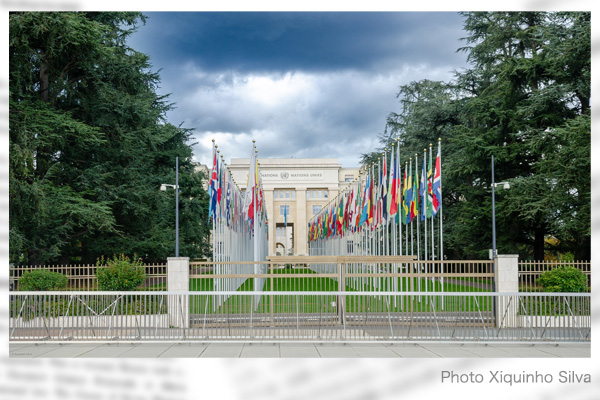
On March 6, 17 United Nations human rights experts (seven special rapporteurs appointed by the U.N. Human Rights Council and 10 members of two relevant working groups) issued a press release expressing grave concern at the continued lack of justice, truth and reparations regarding the wartime comfort women issue and calling on the Japanese government to pay reparations. These experts are working in their individual capacity.
Condemning Japan for the comfort women issue
The experts claimed that up to 200,000 women and girls were reportedly subjected to trafficking, rape, and sexual slavery, as well as to arbitrary deprivation of liberty and, in certain cases, to enforced disappearance and that “previous efforts to address this issue, such as the 2015 bilateral agreement between Japan and the Republic of Korea, have failed to deliver survivor-centered justice.”
Citing the principle of international law that no state can be tried by another state’s court, the experts said, “Sovereign immunity should not serve as grounds to waive accountability for war crimes and crimes against humanity.” Following this logic, the South Korean courts have issued two district court rulings and one high court ruling ordering the Japanese government to pay reparations to former comfort women. The Japanese government has invoked sovereign immunity and does not recognize the proceedings themselves, but the UN human rights experts condemned this stance.
Former comfort women from six countries, including South Korea, China, and Indonesia, filed a petition with the U.N. Human Rights Council for relief, prompting human rights experts to request responses from their and Japanese governments in letters to them in July 2025. The Japanese government rejected the petition based on the Japan-South Korea comfort women agreement and the sovereign immunity principle.
The United Nations institutions, especially the Human Rights Council in Geneva and other human rights-related organizations, have emphasized a framework that views states as potential oppressors of their citizens and have developed mechanisms for victims of human rights abuses to file petitions directly with U.N. organizations without going through their respective governments.
In fact, totalitarian countries such as China and Iran severely oppress their citizens, and in countries where such oppression is intense, governments closely monitor their citizens’ petitions with U.N. organizations and carry out state‑wide propaganda to deny oppression.
On the other hand, liberal democracies, including Japan, have some domestic groups that try to degrade their own countries even by distorting facts. These groups have exploited the United Nations to spread their lies and put pressure on their governments. Japanese groups such as the Buraku Liberation League and the Japan Federation of Bar Associations began their activities at the United Nations as early as the late 1980s.
Inherit Abe's wish
Regarding the comfort women issue, the Japanese government under then Prime Minister Shinzo Abe launched public communications in 2016 to deny an allegation that 200,000 women were coercively recruited as sex slaves. However, the government made no mention of this denial in its response to the U.N. human rights experts’ letter. Abe told the National Diet that the government would respond to the slander about comfort women that was spreading in the international community. Returning to that starting point, the current Sanae Takaichi administration should strengthen its government‑wide efforts on issues related to historical awareness.
Tsutomu Nishioka is a senior fellow and a Planning Committee member at the Japan Institute for National Fundamentals and a specially-appointed professor at Reitaku University. He covers South and North Koreas.
 Takashi Arimoto
 Tadae Takubo
 Fumio Ota
 Yoshiko Sakurai
 Yasushi Tomiyama
 Masahiko Hosokawa
 Yoichi Shimada
 Hiroshi Yuasa
 Tadashi Narabayashi
 Hideo Tamura
 Kiyofumi Iwata
 Kunio Orita
 Maki Nakagawa
 Etsuro Honda
 Yujiro Oiwa
 Hironobu Ishikawa
 Shiro Takahashi
 Katsuhiko Takaike
 Michio Ezaki
 Akira Momochi
 Akio Yaita
 Yoshihiko Yamada
 Seiji Kurosawa
 Koichi Endo
 Brahma Chellaney
 Nobuko Araki
 Yang Haiying
 James Auer
 Sumihiko Kawamura
 Hiroshi Kimura
 Osamu Nishi
 Koko Kato
 Tadashi Saito
 Shohei Umezawa
 Jason Morgan
 Arvind Gupta
 Kenro Nagoshi
 Takeshi Kudo
 Sukehiro Hirakawa
 Yumiko Nishimoto
 Rikiwo Shikama
 Eriko Yamatani
 Koichi Furusho
 Tadashi Ito
 Satoshi Hirano
 Lee Woo Young
 Taro Yayama
 Koh Sekai
 Koji Okamoto
 Tsutomu Toichi
 Hideaki Karaki
 Toshu Noguchi
 Kichinosuke Ihara
 Hisashi Matsumoto
 Yasuyuki Takai
 Nobuyuki Sato
 Chung Dae Kyun
 Toshio Watanabe
 Katsuya Tsukamoto
 Kazuto Suzuki
 Koichi Mera
 Akihisa Nagashima
 Miki Kase
 Eitaro Ogawa
 Hirotaka Watanabe
 Akinaka Senzaki
 Kevin Maher
 Yang Yi
 Hidetake Sawa
 Satoshi Tomisaka
 Nobukatsu Fujioka
 Masanori Kondo
 Hiroshi Ito
 Mio Sugita
 Rupakjyoti Borah
 Seiichi Okutomi
 Saburo Tsukamoto
 Yasuo Naito
 Satoshi Sakakibara
 Yen-Hung Lin
 Sanae Takaichi
 Haruhisa Nakagawa
 Norihide Miyoshi
 Syunichi Akasofu
 Ryoichi Hamamoto
 Hong Hyung
 Andrii Gurenko
 Ronald Morse
 Kazuhiko Inoue
 Keiichi Nakagawa
 Masamori Sase
 Katsutoshi Kawano
 Tomohisa Takei