On April 30, the New History National Movement to wage history wars was launched in South Korea. Its three co-representatives are Lee Young Hoon, a former professor at Seoul National University who edited and authored the best-selling book “Anti-Japan Tribalism;” Ryu Seok Chun, a former professor at Yonsei University who was prosecuted for describing comfort women as a type of prostitutes in his university lecture and acquitted after a five-year court battle; and archaeologist Choi Sung Rak, a professor emeritus at Mokpo National University.
Challenging the leftist view of history
They expressed a sense of crisis by saying: “Today, the Republic of Korea is facing domestic and external challenges to question the existence of its national system. Domestically, leftist forces that have denied the nation’s historical legitimacy built a politically strong hegemony. Outside the nation, communist China has risen to challenge the hegemony of the United States, ushering in a historic shift in international politics. The Republic of Korea has once again faced a crossroads of life or death.”
They said the crisis has been caused because the existing conservative parties have “refused to be like conservative parties that have led the nation’s defense, economic prosperity, and democratization.” In order to reconstruct conservative movement, it is first necessary, they said, to “dismantle the false system built by the left in the field of history and establish a new system of history,” explaining the purpose of the national movement.
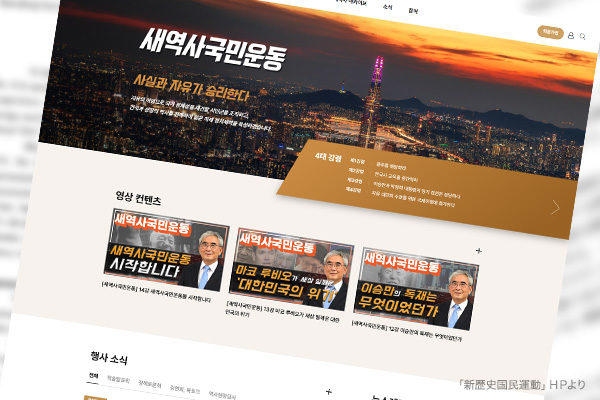
Under the slogan of “Facts and Freedom Win,” the national movement is recruiting members through a poster characterizing the movement as “the headquarters for history wars against forces that deny the Republic of Korea” and as “a citizen’s army to reestablish national legitimacy on the principle of freedom.”
The co-representatives have put forward four missions for the movement: (1) liberate Gwangju, (2) discontinue Korean history education, (3) justify long-term rules under Presidents Syngman Rhee and Park Chung Hee, and (4) participate in an international war to protect free Taiwan.
The first mission represents an accusation that the nation’s official history has adopted the historical perspective which unilaterally defines a clash between pro-democracy demonstrators and martial law troops in Gwangju in the run-up to the inauguration of the Chun Doo Hwan government in 1980 as a massacre by the military, and, by extension, defines the suppression of armed communist uprisings during the founding of South Korea as massacres by the government.
The second mission calls for stopping the current history education that denies the legitimacy of the Republic of Korea. The third mission emphasizes positive aspects of modern Korean history. The three missions challenge negative historical views on the Republic of Korea.
From such standpoint, the national movement regards the arrest and criminal prosecution of Kim Byung Heon, who led a movement to deny the coercive recruitment of wartime comfort women, represents a crisis for South Korea’s freedom and pursuit of truth. It plans to support Kim on trial.
Advocating participation in Taiwan’s defense
Regarding the fourth mission, the national movement leaders emphasized that, in response to external challenges, namely the attempt by Chinese Communist forces to expand their influence in East Asia, South Korea should participate in a war to defend Taiwan while upholding the value of freedom. This is very noteworthy. “If China were to recklessly start a war against Taiwan, it would likely be because it is tempted by the judgment that Koreans would cowardly treat that war as someone else’s problem,” they said. “If South Korea strongly expressed its willingness to participate in a war and protect Taiwan’s freedom and democracy, China would abandon its plans to invade Taiwan.”
While I have been advocating solidarity between Japanese and South Korean conservatives for more than 20 years, the biggest obstacle has been the falsified history, including the comfort women issue, fabricated by Japanese and South Korean leftists. The national movement that directly challenges the falsified history has finally been launched in South Korea. I have high hopes for its future.
Tsutomu Nishioka is a senior fellow and a Planning Committee member at the Japan Institute for National Fundamentals and a specially-appointed professor at Reitaku University. He covers South and North Koreas.
 Takashi Arimoto
 Tadae Takubo
 Fumio Ota
 Yoshiko Sakurai
 Yasushi Tomiyama
 Masahiko Hosokawa
 Yoichi Shimada
 Hiroshi Yuasa
 Tadashi Narabayashi
 Hideo Tamura
 Kiyofumi Iwata
 Kunio Orita
 Maki Nakagawa
 Etsuro Honda
 Yujiro Oiwa
 Hironobu Ishikawa
 Shiro Takahashi
 Katsuhiko Takaike
 Michio Ezaki
 Akira Momochi
 Akio Yaita
 Yoshihiko Yamada
 Seiji Kurosawa
 Koichi Endo
 Brahma Chellaney
 Nobuko Araki
 Yang Haiying
 James Auer
 Sumihiko Kawamura
 Hiroshi Kimura
 Osamu Nishi
 Koko Kato
 Tadashi Saito
 Shohei Umezawa
 Jason Morgan
 Arvind Gupta
 Kenro Nagoshi
 Takeshi Kudo
 Sukehiro Hirakawa
 Yumiko Nishimoto
 Rikiwo Shikama
 Eriko Yamatani
 Koichi Furusho
 Tadashi Ito
 Satoshi Hirano
 Lee Woo Young
 Taro Yayama
 Koh Sekai
 Koji Okamoto
 Tsutomu Toichi
 Hideaki Karaki
 Toshu Noguchi
 Kichinosuke Ihara
 Hisashi Matsumoto
 Yasuyuki Takai
 Nobuyuki Sato
 Chung Dae Kyun
 Toshio Watanabe
 Katsuya Tsukamoto
 Kazuto Suzuki
 Koichi Mera
 Akihisa Nagashima
 Miki Kase
 Eitaro Ogawa
 Hirotaka Watanabe
 Akinaka Senzaki
 Kevin Maher
 Yang Yi
 Hidetake Sawa
 Satoshi Tomisaka
 Nobukatsu Fujioka
 Masanori Kondo
 Hiroshi Ito
 Mio Sugita
 Rupakjyoti Borah
 Seiichi Okutomi
 Saburo Tsukamoto
 Yasuo Naito
 Satoshi Sakakibara
 Yen-Hung Lin
 Sanae Takaichi
 Haruhisa Nakagawa
 Norihide Miyoshi
 Syunichi Akasofu
 Ryoichi Hamamoto
 Hong Hyung
 Andrii Gurenko
 Ronald Morse
 Kazuhiko Inoue
 Keiichi Nakagawa
 Masamori Sase
 Katsutoshi Kawano
 Tomohisa Takei