The future of Iran’s counterstrikes following a surprise attack by the United States and Israel remains uncertain. Although large-scale surface-to-surface missile launches have decreased, attacks by Shahed suicide drones on tankers and key facilities in neighboring countries continue. Experts have called Iran’s relentless counterstrikes a war of “magazine depth,” but the Shahed attacks also reveal that this conflict has become an industrial-base war in which Iran, like Ukraine fighting against Russia, is producing military equipment while continuing the war. The Shahed is simple in structure and inexpensive to manufacture. Even if a ceasefire is achieved eventually, the embers of conflict are unlikely to be extinguished.
Contributing to safe passage after ceasefire
While Iran has claimed to have laid mines in the Persian Gulf, no mine-laying operations have been sighted, with no ships hitting mines. However, simple influence mines and improvised explosive mines are easy to manufacture and lay. The low credibility of the Iranian claim does not mean the Persian Gulf is safe. Just as wartime mines are found in Japan 80 years after World War II, mines that were laid in the Persian Gulf during past wars may have been buried in sand without ever being cleared. Safety from mines increases as a result of cumulative minesweeping efforts.
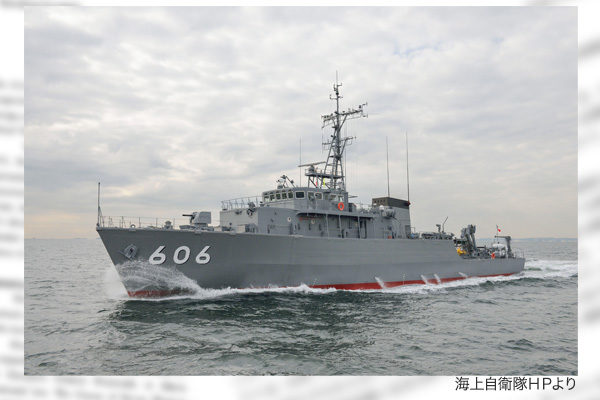
Japan is deeply dependent on Persian Gulf oil resources. If a ceasefire is achieved, Japan will actively contribute to ensuring the security of the Persian Gulf. Minesweeping is the most effective way for Japan to contribute. Based on Japan’s experience of having starved its people due to naval mines during World War II, its Maritime Self-Defense Force has continuously inherited and honed minesweeping skills.
Since 2012, the MSDF has continued to participate in multilateral minesweeping exercises hosted by the U.S. Central Command in the Persian Gulf. Small minesweepers have limitations in speed and range, and take more than a month to sail from Japan. Even with reinforced‑plastic hulls, navigation in the Indian Ocean is demanding.
For this reason, the idea of stationing Japanese minesweepers in the Persian Gulf and replacing their crews by air has emerged frequently.
Advantage will outweigh cost
The MSDF has a lot to gain from the stationing of minesweepers in the Persian Gulf. In a harsh operating environment that is completely different from Japan’s, the MSDF will be able to gain experience with a wide variety of mines and the latest minesweeping technology. The Persian Gulf has a deep entrance but shallow waters inside. The salinity of the sea surface differs from that of the seabed due to high temperatures, causing irregular water currents. Minesweeping there requires a high level of skill and proficiency. MSDF minesweepers may not be able to begin operations upon arrival from Japan.
Politically, the minesweepers will provide a visible presence in the Persian Gulf and, above all, enable Japan to commit to regional peace and stability without delay.
If Japan continues to depend on the Persian Gulf for energy resources, the security of the Persian Gulf remains a key national interest. As long as Iran exists, armed conflicts may not disappear from the Persian Gulf. For Japan, the advantage of stationing minesweepers there in peacetime will surely outweigh the cost of removing one or two minesweepers from the domestic defense structure.
Tomohisa Takei is a member of the Planning Committee at the Japan Institute for National Fundamentals. Formerly, he served as Chief of Staff of the Japan Maritime Self-Defense Force.
 Tsutomu Nishioka
 Takashi Arimoto
 Tadae Takubo
 Fumio Ota
 Yoshiko Sakurai
 Yasushi Tomiyama
 Masahiko Hosokawa
 Yoichi Shimada
 Hiroshi Yuasa
 Tadashi Narabayashi
 Hideo Tamura
 Kiyofumi Iwata
 Kunio Orita
 Maki Nakagawa
 Etsuro Honda
 Yujiro Oiwa
 Hironobu Ishikawa
 Shiro Takahashi
 Katsuhiko Takaike
 Michio Ezaki
 Akira Momochi
 Akio Yaita
 Yoshihiko Yamada
 Seiji Kurosawa
 Koichi Endo
 Brahma Chellaney
 Nobuko Araki
 Yang Haiying
 James Auer
 Sumihiko Kawamura
 Hiroshi Kimura
 Osamu Nishi
 Koko Kato
 Tadashi Saito
 Shohei Umezawa
 Jason Morgan
 Arvind Gupta
 Kenro Nagoshi
 Takeshi Kudo
 Sukehiro Hirakawa
 Yumiko Nishimoto
 Rikiwo Shikama
 Eriko Yamatani
 Koichi Furusho
 Tadashi Ito
 Satoshi Hirano
 Lee Woo Young
 Taro Yayama
 Koh Sekai
 Koji Okamoto
 Tsutomu Toichi
 Hideaki Karaki
 Toshu Noguchi
 Kichinosuke Ihara
 Hisashi Matsumoto
 Yasuyuki Takai
 Nobuyuki Sato
 Chung Dae Kyun
 Toshio Watanabe
 Katsuya Tsukamoto
 Kazuto Suzuki
 Koichi Mera
 Akihisa Nagashima
 Miki Kase
 Eitaro Ogawa
 Hirotaka Watanabe
 Akinaka Senzaki
 Kevin Maher
 Yang Yi
 Hidetake Sawa
 Satoshi Tomisaka
 Nobukatsu Fujioka
 Masanori Kondo
 Hiroshi Ito
 Mio Sugita
 Rupakjyoti Borah
 Seiichi Okutomi
 Saburo Tsukamoto
 Yasuo Naito
 Satoshi Sakakibara
 Yen-Hung Lin
 Sanae Takaichi
 Haruhisa Nakagawa
 Norihide Miyoshi
 Syunichi Akasofu
 Ryoichi Hamamoto
 Hong Hyung
 Andrii Gurenko
 Ronald Morse
 Kazuhiko Inoue
 Keiichi Nakagawa
 Masamori Sase
 Katsutoshi Kawano