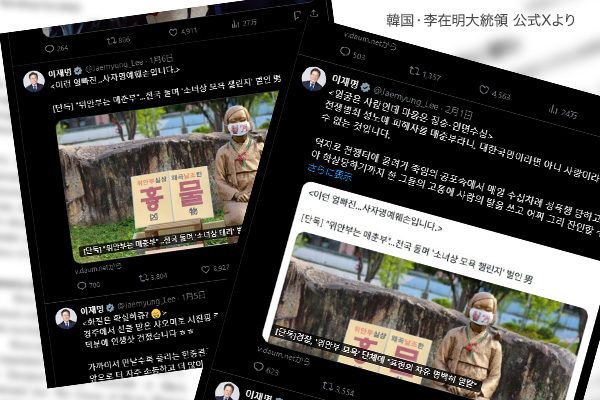
On March 20, South Korean police arrested Kim Byung Heon, representative of the National Action to Abolish the Comfort Women Act, who has been campaigning for the removal of comfort woman statues. The rule of law and freedom of speech in South Korea are being seriously undermined. As a neighbor, I feel strong concern about the situation.
As reported in the “Speaking Out” column on February 16, South Korean President Lee Jae Myung criticized Kim’s activities as “defamation of the deceased” through social media in January, leading the police to search his house once and interrogate him twice at a police station. On March 17, the prosecution requested an arrest warrant for Kim from the Seoul District Court at the request of the police. In South Korea, a court conducts a preliminary review of any arrest warrant. On March 20, the Seoul District Court conducted the preliminary review. Kim then presented primary materials and made a correct argument that “there was no comfort woman who was coercively recruited by the Japanese military.” However, the arrest warrant for Kim was issued on the ground that he could escape. Kim was taken to a detention center.
Arrest of activist opposing comfort women statues
The court said that Kim might flee to Japan because he had close ties to Japanese civic groups. However, Kim’s supporters indignantly insist that as he has been barred from leaving the country, the only way for him to escape to Japan is to stow away.
Kim was charged with violating the Assembly and Demonstration Act and the Child Welfare Act, as well as with defamation of the deceased and defamation on communication networks.
The act deemed a violation of the Assembly and Demonstration Act consisted only of taking commemorative photos with a banner reading “Have you put up a comfort woman (prostitute) statue in the schoolyard to provide career guidance for prostitution?” after rallies near high schools where comfort woman statues had been installed were denied permission. Kim did not use loudspeakers or make speeches. The arrest warrant specified that Kim spent one minute and seven minutes, respectively, taking photos on two occasions. If such an act amounts to an illegal assembly, all acts of taking commemorative photos could be considered illegal.
The three alleged victims of defamation were three former comfort women: the late Gil Won Ok, Lee Yong Soo, and Park Pil Geun. Kim has claimed based on their own testimonies that (1) Gil Won Ok was not taken by the Japanese military; (2) Lee Yong Soo said she was poor and happily followed a Japanese who gave her a dress and leather shoes; and (3) although Park Pil Geun described herself as having lived as a comfort woman in Japan, there were no comfort stations in Japan. These claims were treated as lies to defame them. However, Kim’s claims are based on a collection of testimonies compiled by comfort women-supporting organization, the Korean Council for the Women Drafted for Military Sexual Slavery by Japan. His claims should not be dismissed as false.
“Entire nation is telling lies”
Kim said in early March: “I have not done any illegal activities. So as not to hold any illegal assembly, I silently took pictures and went back home. Of course, I have never defamed anyone based on falsehoods. I have been just claiming that there was not a single comfort woman who was forcibly taken away by the Japanese military. If prosecuted, I would like to ask former comfort women at the court to clarify whether they were coercively recruited by the Japanese military. In this sense, the trial is a good opportunity. I am working for the truth. I am not working for Japan. The current situation, in which the entire nation is engaged in telling lies, is not good for South Korea.”
Tsutomu Nishioka is a senior fellow and a Planning Committee member at the Japan Institute for National Fundamentals and a specially-appointed professor at Reitaku University. He covers South and North Koreas.
 Tadae Takubo
 Takashi Arimoto
 Fumio Ota
 Yoshiko Sakurai
 Yasushi Tomiyama
 Masahiko Hosokawa
 Yoichi Shimada
 Hiroshi Yuasa
 Tadashi Narabayashi
 Hideo Tamura
 Kiyofumi Iwata
 Kunio Orita
 Maki Nakagawa
 Etsuro Honda
 Yujiro Oiwa
 Hironobu Ishikawa
 Shiro Takahashi
 Katsuhiko Takaike
 Michio Ezaki
 Akira Momochi
 Akio Yaita
 Yoshihiko Yamada
 Seiji Kurosawa
 Koichi Endo
 Brahma Chellaney
 Nobuko Araki
 Yang Haiying
 James Auer
 Sumihiko Kawamura
 Hiroshi Kimura
 Osamu Nishi
 Koko Kato
 Tadashi Saito
 Shohei Umezawa
 Jason Morgan
 Arvind Gupta
 Kenro Nagoshi
 Takeshi Kudo
 Sukehiro Hirakawa
 Yumiko Nishimoto
 Rikiwo Shikama
 Eriko Yamatani
 Koichi Furusho
 Tadashi Ito
 Satoshi Hirano
 Lee Woo Young
 Taro Yayama
 Koh Sekai
 Koji Okamoto
 Tsutomu Toichi
 Hideaki Karaki
 Toshu Noguchi
 Kichinosuke Ihara
 Hisashi Matsumoto
 Yasuyuki Takai
 Nobuyuki Sato
 Chung Dae Kyun
 Toshio Watanabe
 Katsuya Tsukamoto
 Kazuto Suzuki
 Koichi Mera
 Akihisa Nagashima
 Miki Kase
 Eitaro Ogawa
 Hirotaka Watanabe
 Akinaka Senzaki
 Kevin Maher
 Yang Yi
 Hidetake Sawa
 Satoshi Tomisaka
 Nobukatsu Fujioka
 Masanori Kondo
 Hiroshi Ito
 Mio Sugita
 Rupakjyoti Borah
 Seiichi Okutomi
 Saburo Tsukamoto
 Yasuo Naito
 Satoshi Sakakibara
 Yen-Hung Lin
 Sanae Takaichi
 Haruhisa Nakagawa
 Norihide Miyoshi
 Syunichi Akasofu
 Ryoichi Hamamoto
 Hong Hyung
 Andrii Gurenko
 Ronald Morse
 Kazuhiko Inoue
 Keiichi Nakagawa
 Masamori Sase
 Katsutoshi Kawano
 Tomohisa Takei